

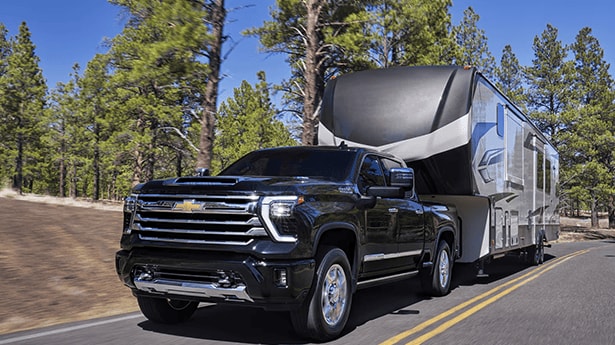
Trucks parked at job sites across Wooster often face much more demanding conditions than the average commuter vehicle. While a 2026 Chevrolet Silverado 1500 is engineered for longevity, the way you use it determines the frequency of necessary maintenance. When your truck is constantly loaded with tools or pulling a trailer, the internal components operate at higher temperatures for longer periods. This sustained heat accelerates the breakdown of lubricants and puts additional stress on the cooling system. We see many trucks that handle weekend DIY projects with ease, but those used for daily commercial hauling require a more proactive approach to service to prevent premature wear on the 5.3L V8 or the 3.0L Duramax Turbo-Diesel engine.
The local environment plays a significant role in how your truck ages. Between the humidity of an Ohio summer and the heavy road salt used during our winters, the chassis and undercarriage of your vehicle are under constant attack. For owners who frequently navigate the gravel routes and agricultural areas around Wooster, dust infiltration becomes a primary concern. Fine particulates can clog air filters and find their way into sensitive electrical connections. Regularly cleaning the underbody and inspecting the intake system helps ensure that the 430 lb-ft of torque provided by the Duramax Turbo-Diesel engine remains available when you need it most.
Maintaining a truck used for work is about protecting your investment and ensuring reliability. If you have questions about how your specific usage affects your maintenance needs, our team is available for a quick call at (330) 439-4949 to discuss a tailored plan. We understand that a truck in the shop is a truck that isn't earning, so we focus on high-efficiency service that addresses potential issues before they cause an unscheduled breakdown. If you are heading into town for supplies, our service center location is easy to find on West Old Lincoln Way.
Severe-Duty Maintenance Schedules for Frequent Towing and Hauling
Does your truck spend more than half its time with a trailer attached or a full payload in the bed? If the answer is yes, the standard maintenance intervals listed in your owner’s manual likely do not apply to you. Chevrolet defines "severe service" as frequent towing, hauling near maximum capacity, or idling for extended periods. Under these conditions, the engine oil, transmission fluid, and differential lubricants degrade much faster. For a 2026 Chevrolet Silverado 1500, we typically recommend moving to a 5,000-mile oil change interval rather than waiting for the maximum limit, as the additive packages in the oil can deplete rapidly under high-load heat.
Transmission health is the most critical factor for towing longevity. While standard intervals might suggest a long wait for transmission service, heavy-duty use often requires a fluid exchange as early as 45,000 miles. This is especially true for the 10-speed automatic paired with the Duramax 3.0L Turbo-Diesel. Fresh fluid ensures that the clutches inside the transmission can grab effectively without slipping, which is vital when you are pulling 13,300 pounds up a grade. To keep your schedule on track, you can book a maintenance visit through our online portal.
Beyond fluids, severe-duty use requires frequent inspections of the transfer case and cooling system. The transfer case fluid in 4WD models like the 2026 Chevrolet Colorado should be checked for clarity and level every 30,000 miles if you are frequently using the truck for off-road work or in snowy conditions. If you prefer to handle smaller maintenance tasks yourself, our team can help you order genuine GM fluids and filters to ensure you are using the correct specifications for your specific powertrain.
Vital Brake and Tire Care for Managing Heavy Loads
Heavy loads on the back roads of Honeytown place an immense burden on your truck's friction surfaces. When you increase the gross combined weight of your vehicle, the kinetic energy that the brakes must dissipate as heat grows exponentially. This can lead to "brake fade," where the pads and rotors become so hot they lose their effectiveness. For trucks used for towing, we recommend a visual inspection of the brake pads every 7,500 miles. If you notice a "spongy" feel in the pedal or hear a high-pitched squeal, the pads likely need replacement before your next big haul.
Tires are the only point of contact between your truck and the road, and they wear differently when the rear axle is heavily weighted. A truck used for hauling will often see the rear tires wear faster in the center of the tread due to the increased pressure. Rotating your tires every 5,000 to 7,500 miles is non-negotiable for maintaining even tread depth. We also suggest checking the sidewalls for "weather checking" or small cracks, which can be exacerbated by the weight of a heavy trailer.
If your truck is equipped with the Max Trailering Package, it likely features specific suspension tuning and cooling upgrades designed to handle these stresses. However, even the best hardware requires a proper setup. Ensuring your tires are inflated to the "Cold PSI" listed on your driver-side door jamb—not the maximum PSI listed on the tire itself—is essential for safe handling. This ensures the tire footprint is optimized for the weight of the 2026 Chevrolet Silverado 2500HD and its cargo.
Protecting Your Powertrain: Transmission, Differential, and Engine Oil Service
Engine oil temperatures can spike by 20 to 30 degrees during a long climb with a trailer. This thermal stress breaks down the viscosity of the oil, reducing its ability to protect the cylinder walls and bearings. While the Oil Life Monitoring System in the 2026 Chevrolet Silverado 1500 is highly accurate, it is a mathematical model based on engine revolutions and temperature. If you are frequently pushing the 6.2L V8 to its limits, changing the oil before the monitor hits zero percent provides an extra layer of protection for the internal components.
Differential service is often the most overlooked part of truck maintenance. The rear differential gear set is responsible for transferring all that engine torque to the wheels, and the fluid inside can become contaminated with microscopic metal shavings over time. For trucks used for heavy hauling, we suggest a differential fluid change every 30,000 miles. This is a small price to pay to avoid the "whining" or "howling" noises that signal gear wear. Using high-quality synthetic gear oil helps dissipate heat and ensures the limited-slip components in the Custom Trail Boss trim continue to function correctly.
Transmission fluid doesn't just lubricate; it also acts as a hydraulic fluid to change gears and a coolant to pull heat away from the torque converter. If the fluid smells burnt or looks dark brown instead of bright red or pink, it has been overheated. We recommend a "drain and fill" service rather than a high-pressure flush, as this safely refreshes the additive package without dislodging debris that could clog small valves. Keeping these fluids fresh is the best way to ensure your powertrain lasts well beyond the 5 years / 60,000 miles powertrain warranty.
Essential Pre-Tow Inspections and Safety System Calibration
Many drivers assume that a hitch is a "set it and forget it" piece of equipment, but the vibrations of the road can loosen mounting bolts over time. Before every trip through the rolling terrain near Smithville, you should perform a "walk-around" inspection. Check the hitch receiver for signs of rust or hairline cracks and ensure the safety chains are crossed under the trailer tongue. This crossing creates a "cradle" that can catch the tongue if the coupler ever fails, preventing it from digging into the pavement.
Modern Chevy trucks come with advanced trailering technology, such as the In-Vehicle Trailering App and available camera views. If you have recently serviced your truck or disconnected the battery, you may need to recalibrate these systems. The Transparent Trailer View, for example, requires specific measurements of your trailer to function correctly. Taking ten minutes to verify these settings in the infotainment system ensures that your blind-spot monitors and hitch guidance lines are accurate before you pull out onto the highway.
Lighting is another critical safety area that often fails due to corroded pins in the 7-way connector. We recommend applying a small amount of dielectric grease to the plug to prevent moisture from causing a short circuit. If your trailer has its own battery for the breakaway system, test it to ensure it can hold a charge. This system is designed to lock the trailer brakes if it becomes detached from the truck—a vital safety feature that only works if the small on-board battery is maintained.
Quick Answers for Maintaining Hard-Working Chevy Pickups
Q: How often should I rotate tires if I only tow on the weekends?
Even occasional towing shifts the wear patterns on your tires. We recommend sticking to a 7,500-mile rotation schedule at a minimum. If you notice the rear tires are wearing faster than the fronts, you should move that service up to every 5,000 miles to maximize the life of the tread.
Q: Do I need to use a different type of oil if I haul heavy loads in the summer?
You should always use the oil viscosity recommended in your owner's manual, such as 0W-20 or 5W-30 depending on the engine. However, we highly recommend using full synthetic oil, as it has much better resistance to thermal breakdown during the high-heat conditions typical of heavy hauling in an Ohio summer.
Q: Why does my transmission shift differently when I am towing?
Most Chevrolet trucks, including the 2026 Chevrolet Silverado 1500, feature a Tow/Haul mode. This recalibrates the shift points to hold gears longer, providing more torque for acceleration and using the engine to help slow the vehicle on descents. It also increases line pressure in the transmission to reduce heat-generating clutch slip.
Q: When should I replace my trailer hitch ball?
Inspect the ball for any flat spots, deep gouges, or signs of thinning. If the chrome plating is peeling and showing significant rust, or if the ball has any "play" when the nut is tightened, it is time for a replacement. A light coat of hitch grease can significantly reduce this wear over time.
Q: Can I check my own transmission fluid level?
Many modern Chevrolet transmissions are "sealed" units without a traditional dipstick. The level must be checked at a specific temperature through a plug on the side of the transmission case. Because this is a precise process, we recommend having it checked by a professional during your routine oil changes.
If you are ready to get your truck prepped for the season, you can find our Wooster service center just off West Old Lincoln Way. For specific questions about parts or maintenance intervals, feel free to give our team a quick call today.
*Prices and MSRP referenced in this article are estimates for informational purposes only and do not constitute an offer to sell. See dealer for complete details. *Fuel economy estimates shown may differ from official EPA ratings and should not be relied upon as a guarantee of actual vehicle performance.